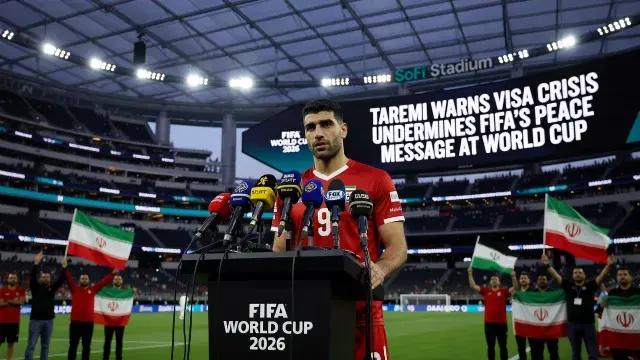
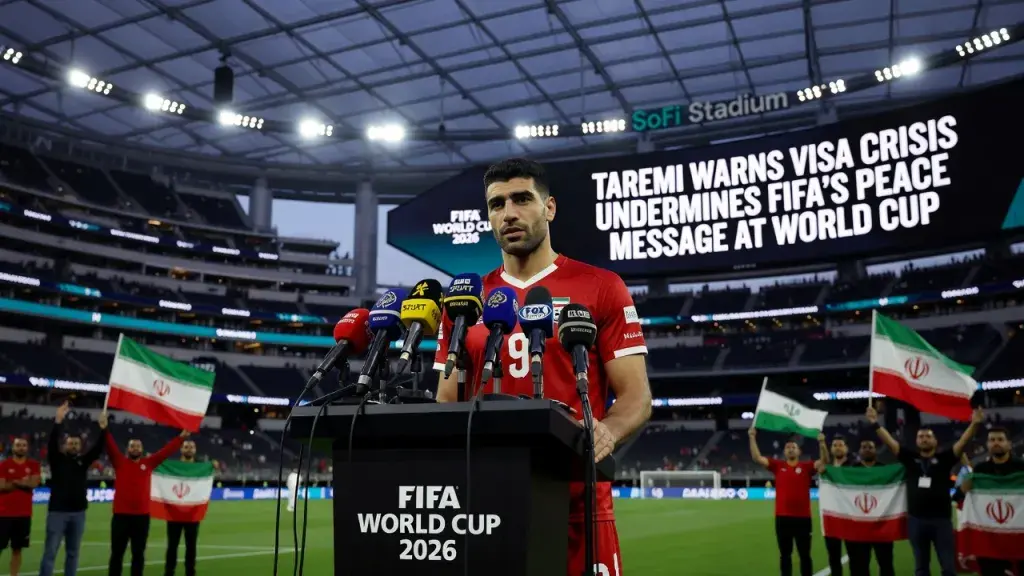
Iran striker Mehdi Taremi arrived in the United States for the 2026 World Cup carrying a familiar weight - not the pressure of goals and group stage points, but the accumulated tension of a political atmosphere that has followed his nation's squad every step of the way. Speaking ahead of Iran's opening match against New Zealand at SoFi Stadium in Los Angeles on Monday, Taremi said plainly that his experience at this tournament feels nothing like the "joy" of Russia 2018 or Qatar 2022. The reason, he made clear, is not football.
The problems are concrete and well-documented. Eleven members of the Iranian delegation - including the team manager, media manager, and executive director - remain unable to enter the United States after being denied visas, and the squad was forced to relocate their pre-tournament training base from Tucson, Arizona to Tijuana, Mexico at short notice. These are not abstract diplomatic irritants; they are logistical disruptions that head coach Amir Ghalenoei said have directly impacted the team's technical preparation. Much like the niche world of water polo betting online, where context and conditions shape outcomes in ways casual observers often overlook, the operational chaos surrounding Iran's World Cup camp has quietly shaped their readiness in ways the scoreboard may eventually reflect. "These conditions have impacted our technical focus," Ghalenoei said, offering a measured but pointed assessment.
Taremi, one of the most experienced players in Iran's squad and a veteran of three consecutive World Cups, went further. He referenced the case of Somali referee Omar Artan - barred from entering the United States and therefore excluded from officiating at the tournament - as evidence that the issue extends well beyond Iran's borders. "It's not just Iran, it's referees being affected," Taremi said. "Of course I have felt tension. We don't have the same beautiful experience as previously, of peace and joy. Several teams had visa issues. Of course there is tension before the tournament has started. It undermines that joy, and the message of FIFA, to our people, of football bringing about peace." His words were careful but damaging to the tournament's stated ideals.
A Federation Under Pressure, a Coach Trying to Stay Focused
An Iran Football Federation official confirmed the situation remains unresolved and active, stating that FIFA has committed to pursuing a resolution ahead of Iran's second group match. The U.S. State Department has not helped matters: a previous statement accused the Iranian party of attempting to "sneak terrorists into U.S." - language that the federation and, implicitly, Taremi's remarks suggest has contributed to the charged atmosphere surrounding the squad's arrival. Iran's camp has responded with studied restraint, though the frustration is audible beneath the diplomatic language.
Ghalenoei, for his part, struck a tone that balanced grievance with professionalism. He thanked journalists for drawing attention to the difficulties his team has faced, while simultaneously steering the conversation back toward football. When pressed on the absence of Sardar Azmoun - one of Iran's most gifted forwards, formerly of Bayer Leverkusen and Roma - Ghalenoei declined to engage with suggestions that the player's omission was politically motivated following a social media post perceived as critical of the Iranian government. "Sardar is an excellent player, he has done a lot for us, he is not with us, we wish he was, but this is football," Ghalenoei said, drawing a comparison to Neymar's periodic absences from Brazil's squad to illustrate that top players can be left out for any number of reasons. The analogy will not satisfy everyone, but it was a deliberate attempt to depoliticise the discussion.
Flags, Courts and a Divided Support Base
The complexity of Iran's position at this World Cup does not end with visa offices and training relocations. Within their own fan community, a significant division exists. A section of supporters intends to display the pre-revolutionary Iranian flag - a potent political symbol representing opposition to the current regime - in the stands at SoFi Stadium. FIFA has moved to block the flag's display, but a legal challenge is currently working through the Californian courts. Iran's team leadership has expressed support for those wishing to bring the flag, and Ghalenoei said his players would not be distracted by whatever unfolds in the stands. "We are not political, but we respect every single Iranian," he said.
The broader political context is impossible to ignore. President Trump declared a ceasefire in his administration's confrontation with Iran almost simultaneously with the Iranian team's flight landing in Los Angeles - a coincidence of timing that underscores just how charged the environment is. FIFA president Gianni Infantino is expected to attend Monday's opener between Iran and New Zealand, a fixture that carries far more symbolic weight than a standard group stage match. Whether football can actually deliver the peace and unity its governing body promises - and whether this World Cup in particular can live up to that aspiration - is a question Taremi asked aloud, with evident sincerity and evident weariness. "I hope in future will be better," he said. It was a quiet but telling conclusion from a player who has given a great deal to the game and found it, this time, tangled up in something much larger than a match.