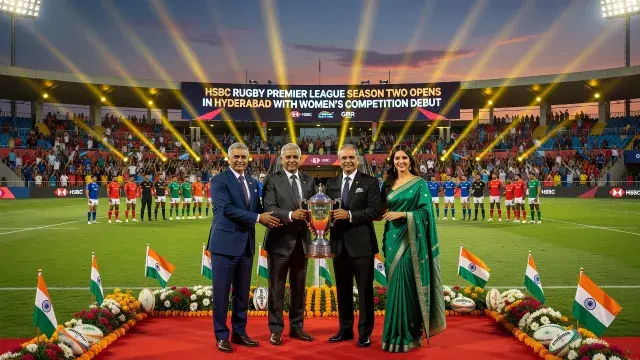
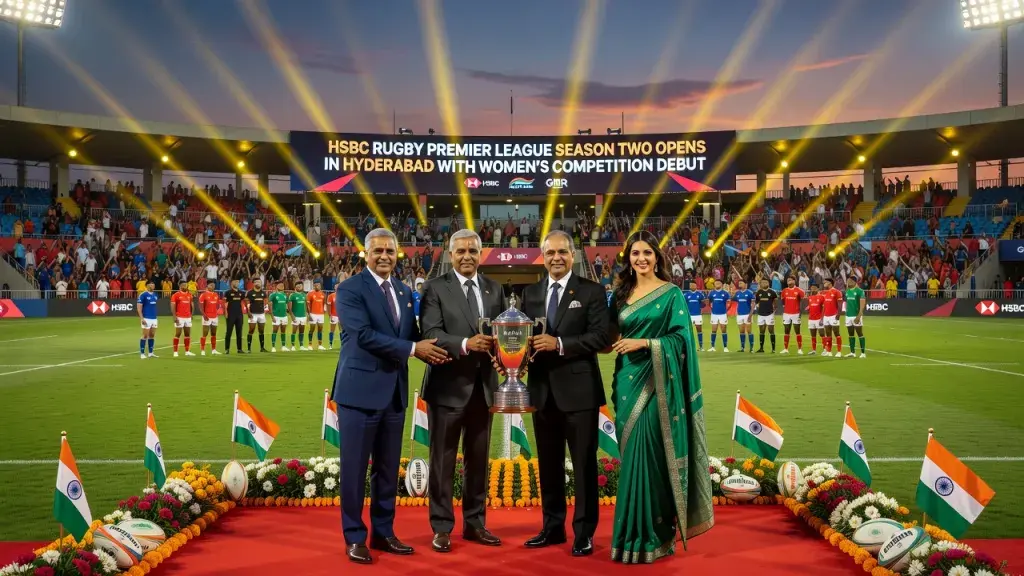
The second edition of the HSBC Rugby Premier League got underway on Tuesday with a high-profile opening ceremony at the Gachibowli Stadium in Hyderabad, signalling a significant step forward for professional rugby in India. The season, which runs until June 28, expands on its debut campaign with six men's city-based franchises and, for the first time, four women's franchises competing for a newly unveiled Women's Trophy. Hyderabad hosts the entire tournament for the first time, adding another major team sport to a city already building a reputation as one of India's premier sporting venues.
The ceremony drew a notable gathering of officials, dignitaries and public figures, including Telangana Sports Minister Vakiti Srihari, GMR Group Corporate Chairman Kiran Kumar Grandhi, Rugby India President Rahul Bose, and actress and singer Shruti Haasan. The event carried a symbolic weight beyond pageantry: it represented a governing body and a state government publicly committing to a sport that remains a work in progress in the Indian market. Much like niche disciplines globally - from handball to, say, pariuri sportive polo - rugby in India is navigating the challenge of building a competitive professional structure while simultaneously growing its grassroots base and audience.
Telangana Steps Up as a Sporting Host
The decision to stage the RPL in Hyderabad reflects deliberate policy rather than coincidence. Minister Vakiti Srihari made the state's ambitions explicit at the ceremony, pointing to sustained infrastructure investment and what he described as "progressive sports policies" as the foundation for attracting events of this scale. The Gachibowli Stadium complex, already familiar to international sport through cricket and athletics, provides the kind of facility that lends credibility to a league still establishing its identity.
Jayesh Ranjan, Special Chief Secretary for Youth Advancement, Tourism, Culture and Sports, reinforced the message, framing the hosting of the RPL as evidence that Hyderabad can stage competitions "of global standards." A. Soni Bala Devi, Vice Chairperson and Managing Director of the Sports Authority of Telangana, added that the organisation had provided comprehensive operational and infrastructure support to ensure the tournament ran smoothly. Taken together, the statements paint a picture of genuine institutional buy-in - the kind of government-level backing that leagues in emerging markets consistently need to survive and eventually flourish.
A Broader Field and a Historic Women's Competition
Rahul Bose, president of Rugby India, set the tone for what the governing body is hoping to achieve this season. Players from 20 countries will feature across the competition - a figure that underscores the league's ambition to serve as a genuinely international platform rather than a domestic-only exercise. More matches per day, redesigned stands intended to bring crowds closer to the action, and in-stadium fan activities are among the on-site improvements cited for Season 2.
The introduction of women's franchises is arguably the most consequential development of this edition. The unveiling of the Women's Trophy at Tuesday's ceremony was more than ceremonial: it marked the RPL formally committing to a dual-gender competition structure at a time when women's rugby globally is growing faster than almost any team sport. For India, where women athletes have historically struggled for visibility and institutional support in team formats, the move carries real significance. Whether the women's competition can generate its own audience and commercial momentum will be one of the defining questions of this season.
What the RPL Needs to Prove
Rugby remains a minority sport in India by any measure, competing for attention in a market dominated by cricket and, increasingly, football. The first season of the RPL provided proof of concept; Season 2 must demonstrate sustainability. A larger international player pool, an expanded format, and a new women's competition all raise the stakes - but they also raise costs and logistical complexity. The Hyderabad government's involvement helps, but the league's long-term health will depend on whether it can convert the ceremony's energy into paying audiences and broadcast engagement over the thirteen days of competition that follow. The tournament runs through June 28, and by the time the finals are played, the RPL will have a clearer sense of how much ground it has genuinely gained.