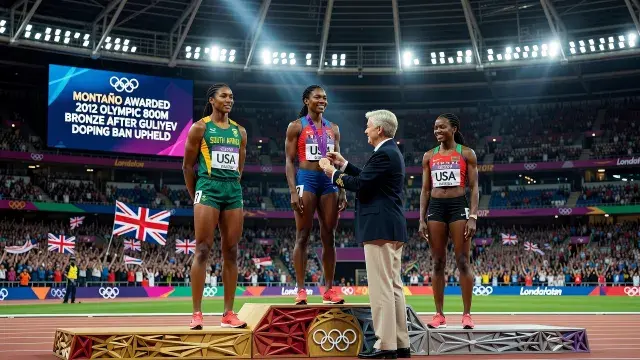
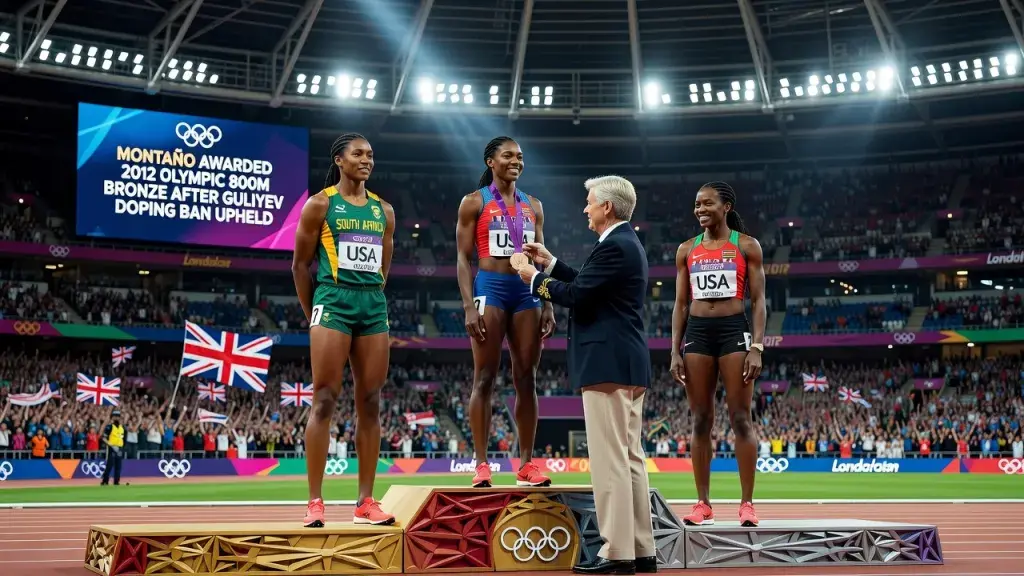
Alysia Montaño has officially been upgraded to the bronze medal position in the women's 800 metres at the 2012 London Olympics, more than a decade after she crossed the finish line in fifth place. The reallocation follows the dismissal of an appeal by Yekaterina Guliyev - who competed at those Games as Yekaterina Poistogova representing Russia - clearing the final legal hurdle for World Athletics and the IOC to formally redistribute the podium places. Kenya's Pamela Jelimo moves up to silver, while Caster Semenya of South Africa retains the gold that was itself reallocated after original winner Mariya Savinova was retroactively disqualified for doping.
A Decade of Legal Process, Finally Resolved
Guliyev's disqualification stems from the sprawling investigation into Russia's state-sponsored doping programme, which reshaped the results of multiple major championships long after the fact. The Court of Arbitration for Sport ruled in March 2024 that it was clear Guliyev had used banned steroids, wiping all of her competitive results between July 17, 2012, and October 20, 2014. Her appeal against that punishment was dismissed in May 2025. It is the kind of protracted, multi-year process that has become a defining feature of athletics' post-scandal reckoning - far removed from the immediacy of, say, online biathlon betting markets that close within seconds of a result, but no less consequential for the athletes whose careers it touches. For Montaño, who retired from competition in 2017, the resolution arrives years after it could have shaped her professional trajectory in real time.
Russia's 2012 London track and field haul originally stood at 18 medals. Sustained anti-doping enforcement has since reduced that figure to four - a statistic that speaks to the scale of the fraud and to the scope of what clean athletes were denied. The 800m final alone has seen two of its original top-three finishers disqualified, leaving a podium that looks entirely different from the one presented on the night.
Montaño's Long Wait - and What She Lost
The bronze in London is not the first retroactive honour Montaño has received. She was already upgraded from fourth to bronze at both the 2011 and 2013 World Championships in the 800m, again as a consequence of doping sanctions applied to Russian athletes. That pattern - of consistently finishing just outside the medals only for investigations to later confirm she had, in fact, earned them - forms the substance of what Montaño described in a social media post when Guliyev's ban was first announced in 2024.
"2012 - 12 years ago. A lot of loss. 3 podium moments that should have happened in real time that didn't?!" she wrote. She went on to describe moving forward knowing the Olympic medal was hers, and expressed no regrets beyond the absence of support at the time. "I ran with integrity," she said. "I represented myself, my family, my country, my friends, my supporters and my community with honor." The post is a reminder of what retroactive justice cannot fully restore: the ceremony, the crowd, the moment of recognition when it would have meant the most.
LA28 and the Question of Meaningful Recognition
The IOC has offered reallocated medallists the choice of when and where to receive their awards, acknowledging that a quiet administrative reassignment falls short of what these athletes deserve. Montaño has made her preference clear - she wants her 2012 Olympic bronze presented at the 2028 Los Angeles Games, on home soil, in front of a full Olympic audience. It is a fitting ambition. LA28 will be the first Summer Olympics held in the United States since Atlanta in 1996, and a medal ceremony on that stage would provide the public recognition that London, through no fault of the competition itself, never delivered.
For the broader sport, the continued enforcement of retroactive sanctions carries a firm institutional message: the records will be corrected, however long it takes. Whether that prospect serves as a meaningful deterrent, or whether it arrives too late to matter for the athletes most affected, is a question athletics continues to grapple with. What is beyond dispute is that Alysia Montaño ran clean, ran well, and is now, officially, an Olympic medallist.