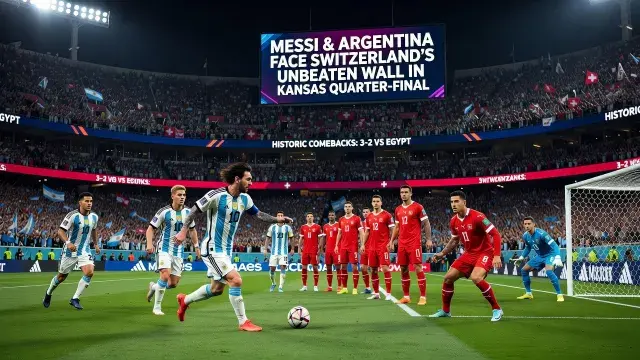
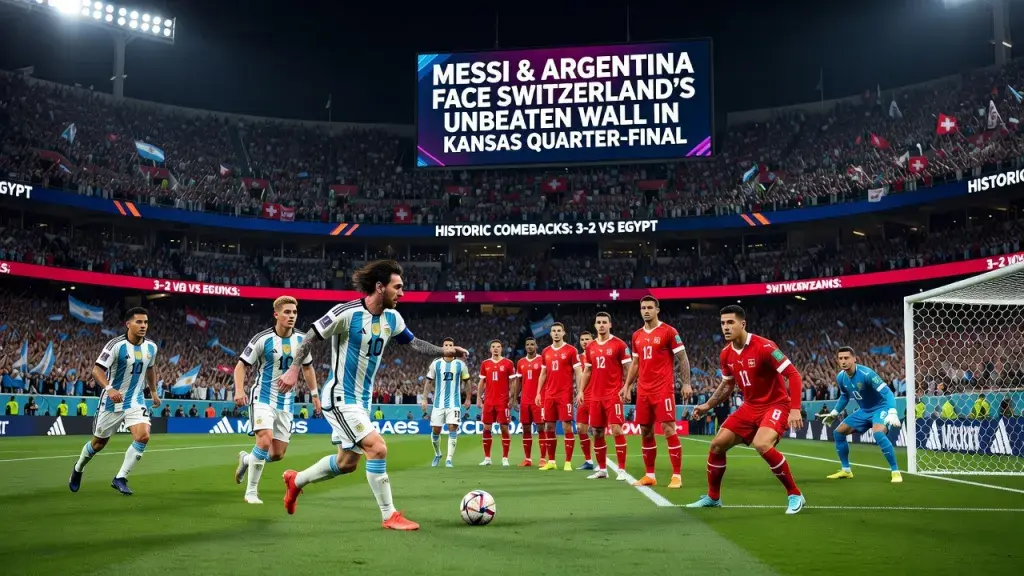
Argentina's defence of their World Cup crown reaches a crossroads on Sunday when they face Switzerland in the quarter-finals in Kansas City, a fixture that pits the tournament's most dramatic survivors against its most quietly composed side. The holders have twice come from the brink of elimination in this tournament, yet somehow find themselves still standing - and still producing history. Switzerland, meanwhile, have not trailed once across 11 matches spanning qualifiers and the finals themselves, arriving at their first last-eight appearance since 1954 with cold-eyed resolve.
The road to Kansas has been anything but smooth for Lionel Scaloni's side. A nervy extra-time win over Cape Verde was followed by one of the most extraordinary comebacks in World Cup history, as Argentina overturned a 2-0 deficit against Egypt with just 12 minutes of normal time remaining to win 3-2. It was, statistically, the latest a team had ever trailed by two or more goals and gone on to win a World Cup match in regulation. Messi set up Cristian Romero's header, then swept in the equaliser himself, before Enzo Fernández's stoppage-time winner sealed it. There are broader conversations happening at this World Cup about veteran stars and scrutiny - the debate around ageing icons and the pressures placed upon them is captured well in pieces such as cancelo defends ronaldo neymar world cup criticism - but for Messi, the response to any doubt has been written in goals and tears on the pitch in equal measure.
At 39, Messi was reduced to tears at the final whistle against Egypt - likely a mixture of exhaustion, relief, and the weight of yet more history made. He became the first player ever to score in six consecutive World Cup knockout matches, while extending his own record to nine finals appearances on the scoresheet overall. His eight goals at this edition are the most of any player before the quarter-final stage, and only Brazil's Ademir, who scored nine at the 1950 tournament, has surpassed that tally for a South American at a single World Cup. There was one unwanted entry in the record books, however: after a penalty was saved by Egypt's Mostafa Shobeir and another missed against Austria in Group J, Messi became the only player in history to fail to convert two spot-kicks at the same World Cup edition.
Argentina's Brilliance in Attack, Fragility at the Back
With Messi, Lautaro Martínez and Julián Álvarez operating in tandem, Argentina have scored in each of their last 14 World Cup games - a run stretching back to a 3-0 group-stage defeat to Croatia at Russia 2018. More telling still, they have netted at least twice in each of their last 11 matches at the finals, matching Uruguay's record set between 1930 and 1954 for the joint-longest such run in the competition's history. They are unbeaten in those 11 games (W9 D2), the longest unbeaten stretch Argentina have ever produced at a World Cup.
But Scaloni cannot afford complacency about his defence. Argentina have conceded five goals from just nine shots on target faced - a conversion rate of 56% against them that is the worst of any remaining quarter-finalist. Only the eliminated sides Uzbekistan and Tunisia gave up goals from a higher proportion of shots on target at this tournament. Switzerland are the only team yet to concede, and should Argentina fall behind early, the anxiety that has already gripped their campaign could become something far harder to manage.
Switzerland: Quiet, Organised and Unbowed by Occasion
Murat Yakin has built something genuinely formidable. Switzerland's 11-match unbeaten run without ever trailing - across six qualifiers and five finals matches - speaks to a defensive discipline that is both tactical and psychological. Their route to the last eight required a penalty shootout victory over Colombia after a goalless 120 minutes, with Gregor Kobel's crucial save proving decisive in a 4-3 shootout win. The Swiss do not rely on individual brilliance alone; they are a functioning collective, disciplined in shape and intelligent in transition.
Granit Xhaka leads the team's creative engine from midfield. No player at this edition has made more line-breaking passes in the final third than the Swiss captain, who has registered 50 such passes, with only Spain's Rodri (80) exceeding his overall tally of 75 across the whole pitch. Ricardo Rodríguez, who faces the unenviable task of marking or containing Messi on the flank, brings vast experience - his 31 appearances at major tournaments since the 2014 World Cup place him second among all European outfield players before this stage, behind only Harry Kane. Up front, Breel Embolo's recent international form is compelling: 13 goal involvements in his last 17 appearances across all competitions, though his influence was muted against Colombia, managing just one touch inside the penalty area.
History Favours Argentina, But Switzerland Are No Longer Making Up the Numbers
The head-to-head record offers Argentina firm ground. Switzerland have never beaten them across seven meetings in all competitions, with two draws and five defeats. Argentina have won both previous World Cup encounters - 2-0 in 1966 and 1-0 in the 2014 round of 16 in Brazil, which remains the last time these sides met competitively. Switzerland's broader struggles against South American opposition are equally stark: they have won just one of 10 World Cup matches against teams from the continent, a 2-1 victory over Ecuador twelve years ago.
Yet the Swiss were not supposed to eliminate Colombia either, and they did. Sunday in Kansas represents their biggest stage in over seven decades, but Yakin's squad carries enough quality and composure not to be overrun by the occasion. Argentina, for their part, have made a habit of surviving moments they arguably should not have. Whether that resilience is sustainable against a side that has not yet been tested from behind at this tournament is the question that makes this quarter-final genuinely difficult to call - even with pre-match modelling suggesting Argentina win in normal time in just over half of projected scenarios. Expect intensity, expect pressure on both goalkeepers, and expect, as has become something of a theme, Messi somewhere near the centre of it all.