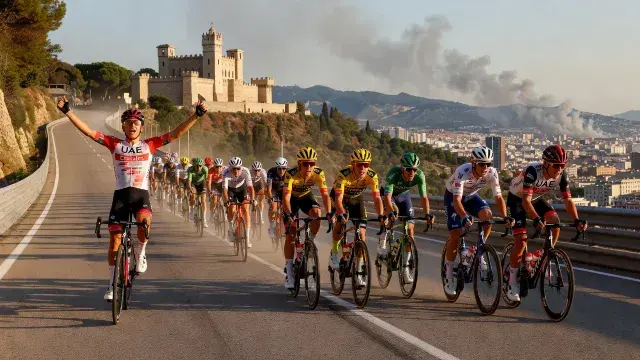
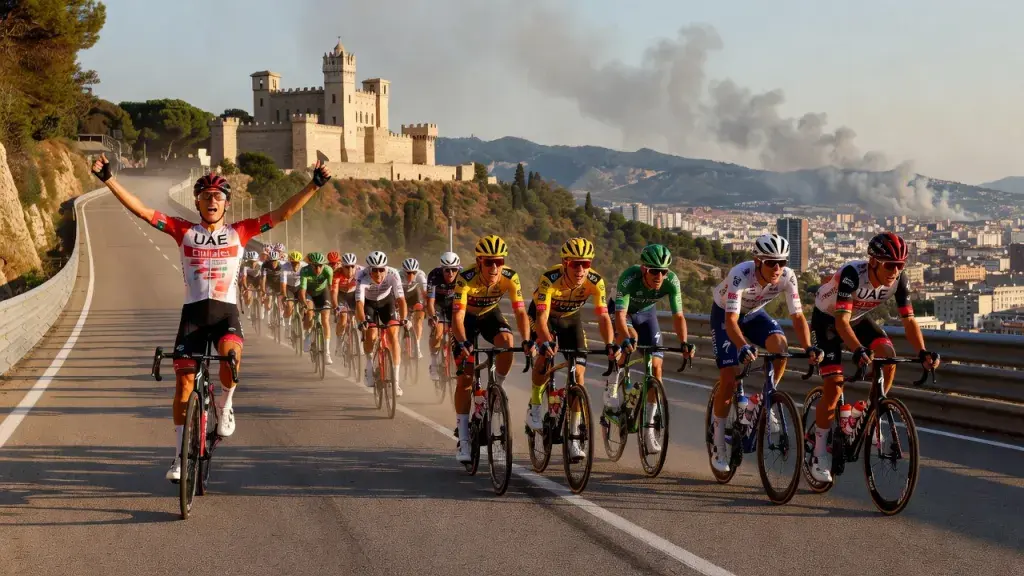
Isaac Del Toro claimed the stage victory on Montjuïc after a day of drama, mechanical misfortune and calculated generosity from his UAE team leader Tadej Pogačar. The Mexican rider, only 20 years old, crossed the line first after Pogačar weaved across the road on the final approach, disrupting the chase and effectively gifting his young team-mate the win. It was the kind of scene that reminded you cycling is sometimes sport, sometimes theatre, and occasionally both at once.
The day had started with a more straightforward breakaway narrative. Alex Molenaar (Caja Rural), Frank van den Broek (Picnic-PostNL) and Felix Engelhardt (Jayco) slipped clear early and stayed clear long enough to contest the intermediate sprint and sweep the king of the mountains points on offer. The surprise was how little resistance they faced - other teams seemingly content to let three riders nobody fears on GC have their moment. Molenaar, a local rider in these roads, picks up the polka-dot jersey as a result. For Caja Rural, a modest return that may still outshine what several bigger outfits manage across three weeks. Elsewhere in the world of competitive sport, results can swing on moments just as fine - much like how furia sweep aurora in esports shows how dominant team performances can emerge from disciplined structure and collective execution rather than individual brilliance alone.
Del Toro's road to victory was anything but smooth. With 60km remaining he suffered a mechanical and was left stranded on the roadside while his own UAE team cars drove past - first the lead car, then the second, which eventually stopped and sent a mechanic back to him. There were reports that rival team vehicles from Visma and Ineos also provided some assistance, which is prohibited under race regulations (rule 2.3.029), though no formal action was taken, suggesting either the intervention was minor or it went unobserved by officials. Del Toro dropped around two minutes before chasing back, rejoining the peloton with enough time to be a factor at the finish. Paul Seixas had his own puncture drama later in the stage - borrowing a team-mate's bike, taking a replacement, and scrambling back to the bunch just as the Montjuïc circuit began - though he handled the chaos with composure.
McNulty's Engine Room, and the Circuit That Sorted the Race
On the Montjuïc finishing circuit, Brandon McNulty did the kind of work that never appears in the final results but defines how a stage ends. The American pulled the peloton relentlessly across two full laps, shedding riders with every ascent. By the final passage, the group was down to its bones. Richard Carapaz and Mattias Skjelmose probed on the descent, trying to nick a gap, but Del Toro read the move, chased, and carved the final corner to go clear. Jonas Vingegaard and Remco Evenepoel were occupied watching Pogačar, which was the space Del Toro needed. When Pogačar began drifting across the road to impede the sprint, the outcome was settled. He could clearly have won. He chose not to. Whether that reflects trust in his young team-mate, race management thinking, or simply the pleasure of doing something unexpected, Pogačar seemed to take more satisfaction from the gesture than from a routine victory of his own.
A Stage That Punished the Peloton Despite Gentle Gradients
On paper, Stage 3 sits in an awkward category. The 196km route with 3,850 metres of vertical gain qualifies it as a mountain stage, but the defining characteristic of the day's climbs is their width and their gradient - big roads, steady inclines, the kind of terrain where pelotons stay together longer than on the wall-like ascents of the high Alps. The Creu dell Serrà and Can Tollo were the early passes, the Collada de Toses long and manageable for most of its length before steepening to 7-10% over the final 5km on the old side road. Via La Molina - familiar from the Volta a Catalunya - and across into France, the Col du Calvaire offered no serious difficulty. It was Montjuïc that did the real damage, compressing the peloton's attrition into a short, repeated effort. Sixteen riders finished within ten seconds of each other; only ten more arrived within a minute. By 38th place, Mathias Vacek was already over five minutes down. For a stage built on gradual roads, it was a brutal finish.
Wildfire Conditions and the Road to Les Angles
The stage did not take place in a vacuum. Wildfires are active in the Pyrénées-Orientales department, one burning approximately 50km from the course. Race organisers confirmed the stage would proceed as planned but stripped the final 40km - once the route crosses into France - of both the publicity caravan and spectators. The decision, confirmed the previous evening, reflected the pressure on local emergency services: firefighters and local government officials who would ordinarily be deployed to manage race security and crowd safety are committed elsewhere. No red weather warnings are in force, which would carry the legal weight to trigger a stage cancellation, but yellow and orange alerts cover several departments including Pyrénées-Orientales. With temperatures at 30°C and a south-easterly wind pushing the bunch along at pace, conditions were demanding even before the climbs.