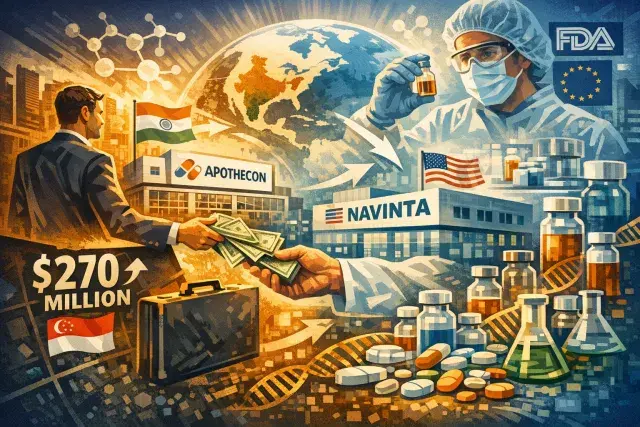
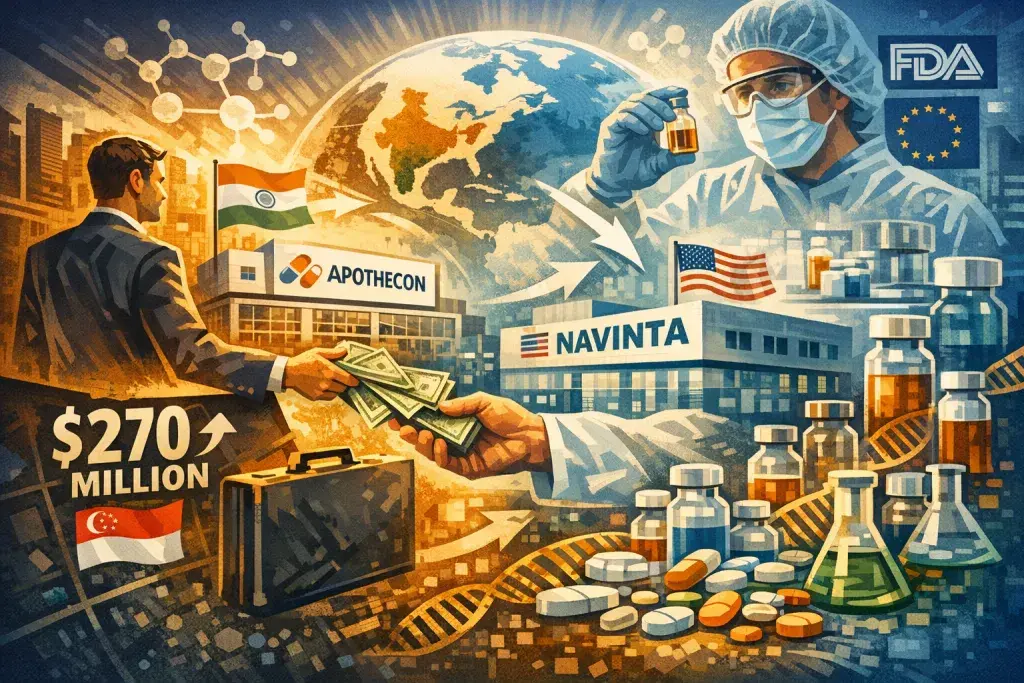
Singapore-based private equity firm Everstone Capital has agreed to invest close to $270 million for a significant stake in Apothecon Group, a specialty pharmaceutical platform spanning India-based Apothecon and US-based Navinta. The deal, announced Tuesday, represents one of the more substantial recent bets on an Indian pharma company with deep manufacturing and regulatory capabilities targeting Western markets. Waymade Capital, Apothecon's European partner, also participated through its investment vehicle.
What Apothecon Actually Does — and Why It Matters
Apothecon Group is not a conventional generics manufacturer. It operates as a regulated-markets-focused specialty formulations business, meaning its products are designed to meet the stringent approval standards of the US Food and Drug Administration and European regulatory authorities — not merely the requirements of lower-barrier emerging markets. That distinction carries significant commercial weight.
The group's portfolio spans injectables, oral solid dosage forms, and other formulations, with in-house capabilities in complex chemistry and captive active pharmaceutical ingredient manufacturing. Captive API production — meaning the company makes its own raw drug substances rather than sourcing them externally — is increasingly valued by buyers and investors alike. It insulates a company from supply chain disruptions, reduces cost volatility, and offers greater control over quality documentation, all of which matter enormously when selling into regulated Western markets.
Apothecon was founded in 2003 by Mahendra Patel, formerly chief scientific officer at Sandoz and a co-founder of Invamed, which Sandoz later acquired, and Joe Renner, who served as chief operating officer of Sandoz and chairman of Zydus US. Both founders carry decades of experience inside multinational pharmaceutical companies, which shaped Apothecon's orientation toward complex formulations and regulatory compliance from the outset. Patel will continue as chairman following the transaction.
Everstone's Strategic Logic in Indian Pharma
This investment extends a clear pattern in Everstone's portfolio construction. The firm has previously backed Rubicon Research, Slayback Pharma, Softgel Healthcare, Integris Medtech, Sahyadri Hospitals, and OmniActive Health — a cluster of investments that together describe a deliberate focus on Indian healthcare businesses with global commercial ambitions. Everstone co-founder and chief investment officer Atul Kapur stated that Apothecon has "built a resilient and self-reliant business model" through its own manufacturing facilities, and framed the investment as part of Everstone's broader track record in scaling healthcare and pharmaceutical businesses internationally.
Everstone has said it will direct resources toward accelerating Apothecon's product pipeline, expanding into new geographies, and pursuing complementary acquisitions. The founding promoters will retain a meaningful stake, preserving alignment between original management and new capital. Puncham Mukim and Arjun Oberoi will join the board as Everstone nominees.
The Broader Private Equity Push Into Indian Specialty Pharma
Everstone's move is consistent with a wider reorientation among private equity firms toward Indian pharmaceutical companies with specialty and complex drug development capabilities. The underlying driver is patent expiration cycles. A significant number of branded drugs — many of them complex injectables, biologics, or specialty oral formulations — are expected to lose patent protection in the US and European markets over the next four to five years. When that happens, the market opens to generic competition, and manufacturers already holding regulatory approvals and production capacity are positioned to capture meaningful revenue quickly.
Indian pharmaceutical companies have spent two decades building manufacturing infrastructure that meets US and European regulatory standards. That investment is now maturing at precisely the moment when the pipeline of patent expirations is widening. For private equity, the calculus is clear: acquire or invest now, before the revenue inflection, and exit once commercial traction is established in regulated markets.
Complex formulations — particularly injectables — represent a more defensible segment than standard oral generics, where margins have eroded sharply due to intense competition and pricing pressure from large US pharmacy chains. Injectable generics require more sophisticated manufacturing processes, carry higher regulatory barriers to entry, and tend to sustain better pricing over time. Apothecon's profile, combining injectable capability with in-house API manufacturing and an existing commercial presence across the US and Europe, fits precisely the kind of asset that commands premium valuations in the current environment.
What Comes Next for the Combined Platform
With fresh capital and an experienced sponsor, Apothecon Group's immediate priorities will likely center on filing additional Abbreviated New Drug Applications with the FDA and corresponding dossiers in European markets, while building out the commercial infrastructure needed to launch products once approvals are secured. Acquisitions, which Everstone has explicitly flagged as part of the strategy, could add therapeutic categories, geographic coverage, or manufacturing capacity that would take years to build organically.
The transaction also signals continued investor confidence in the India-US pharmaceutical corridor — a supply relationship that has faced scrutiny over quality standards and geopolitical dependencies in recent years, but which remains structurally important to global drug supply. Companies that have invested in robust compliance infrastructure, as Apothecon's founders designed from the beginning, are better insulated from the regulatory risk that has tripped up other Indian manufacturers seeking access to Western markets.