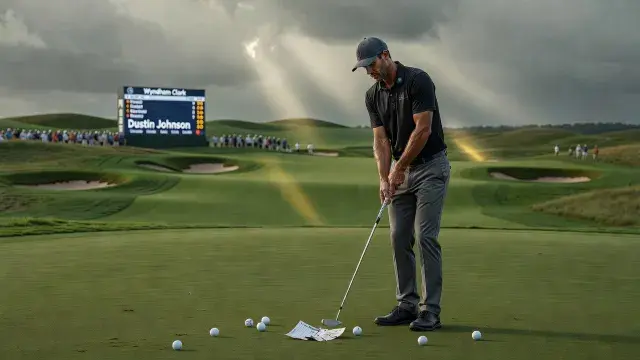
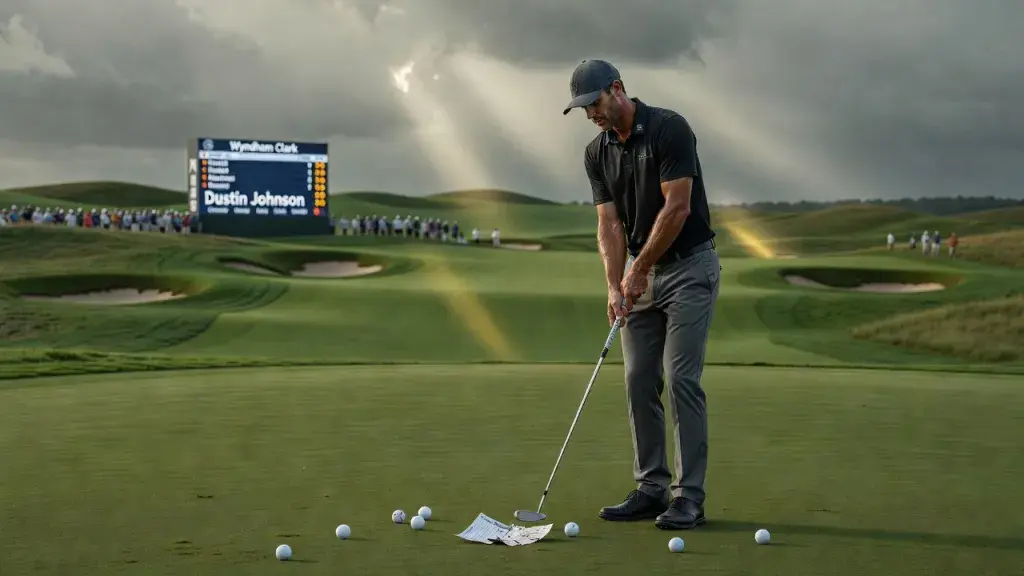
For one brief, tantalising morning at Shinnecock Hills, it looked like Dustin Johnson was turning back the clock. A composed opening 66 had the two-time major champion sitting near the top of the U.S. Open leaderboard, and early in Round 2 he stood just one shot behind Wyndham Clark at four under par. Then, within the space of a single hour, it all unravelled - a double bogey at the 11th, bogeys at 12 and 13, and a catastrophic quadruple-bogey eight at the 15th that shredded his card and his momentum in equal measure. Johnson finished the day at three over par for the tournament, facing an anxious wait to discover whether he has even made the cut.
The collapse was brutal, the kind of back-nine implosion more commonly associated with a club amateur who catches a glimpse of the leaderboard and suddenly feels the weight of the moment. From Johnson, a man who once held the world number one ranking and was spoken of in the same breath as the generation's elite, it carried a different kind of sting - the familiar sting of unfulfilled promise. Golf, like so many individual sports, has its share of dramatic swings in fortune, not unlike the rhythms seen across the sporting world, from tennis Grand Slams to, say, the rising competitive intensity you find when following world padel tour betting markets, where momentum shifts in an instant and the mental game proves every bit as decisive as the physical. For Johnson, mental resilience has always been the defining question.
A Career Defined by the Roads Not Taken
The arc of Dustin Johnson's professional life reads like a case study in squandered opportunity - not through lack of talent, but through an accumulation of moments where circumstance, or the man himself, intervened at the worst possible time. The 2010 PGA Championship at Whistling Straits remains perhaps the most painful single entry in the ledger. Leading by one shot down the 72nd hole, Johnson grounded his club in what he believed was waste area. It was, in fact, a bunker. The two-stroke penalty cost him the lead, a place in the playoff and, ultimately, a major title. He finished tied for fifth.
Then came the years in which his focus off the course drew scrutiny, culminating in a self-imposed leave of absence in 2014. When he returned, the results suggested he had genuinely recalibrated. By 2016 he was standing on the 18th green at Oakmont - navigating both the most unforgiving course in American golf and a contentious mid-round ruling from the USGA - to claim his first major, the U.S. Open. He added the Masters in 2020, playing the Augusta National rescheduled to November due to the COVID-19 pandemic, in arguably the finest sustained performance of his career. Those two major titles remain his ceiling. The 2017 Masters, which he entered as the clear favourite before withdrawing after what was described as a fall down a staircase at the team house, represents perhaps the most tantalising of all the sliding-door moments.
LIV Golf and the Long Decline
When Johnson departed the PGA Tour for LIV Golf in the summer of 2022, he was ranked fifth in the world - a figure that, with hindsight, overstated where his game actually was at that point. The move secured him enormous financial guarantees, but it also removed him from the competitive environment in which world ranking points are accumulated and where the sharpest fields consistently test the best players. He has since dropped to 245th in the world rankings, and that slide is not purely a function of the ranking system's treatment of LIV results. His form on the breakaway circuit has been modest: three victories, none of which have come recently, with this season particularly arduous until a fourth-place finish at LIV Korea and a fifth at LIV Andalucia offered some encouragement heading into Shinnecock.
That recent uptick carried genuine credibility into Round 1, where his 66 was a polished, controlled performance that suggested something might genuinely be stirring. The Round 2 capitulation stripped that narrative bare. He did recover with a birdie at the 16th to give himself a chance of making the weekend, and his two-round total of three over par could yet survive the cut line - but the fact that survival itself is the conversation tells its own story. This was a man who once arrived at major championships as a title favourite, whose physical gifts - the raw power, the silky ball-striking - led serious observers to wonder if he might one day challenge the game's all-time records.
The Lingering Question That Will Follow Him
The most honest assessment of Dustin Johnson's career is that it contains two major championships, a former world number one ranking and a body of work that speaks to a genuinely exceptional talent. It also contains a long, winding list of moments where the gap between what was and what might have been feels almost impossibly wide. The LIV move may well be the final chapter in that list. The financial security it provided is real and rational; what it cost him in competitive sharpness, ranking credibility, and access to the game's biggest stages is also real.
At Shinnecock, for a few holes on a Friday morning, something flickered. Then it went out. When Johnson eventually steps away from the game, the honest retrospective will be a complicated one - two major trophies on the mantle, and the quiet, persistent sense that the full version of Dustin Johnson, had everything aligned just a little differently, might have been something genuinely extraordinary.